


Structured data: how to stand out in Google search results
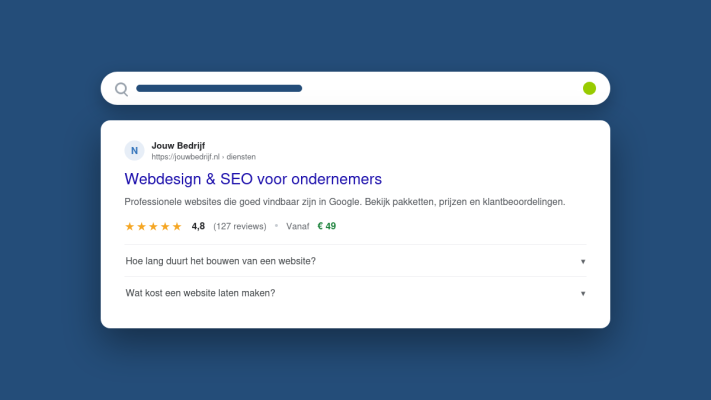
You have probably seen it before: you search for something in Google and some results immediately stand out. They show star ratings, a price, a recipe with prep time, or a list of questions and answers. That is not a coincidence and it is not a paid ad either. These are called rich results, and they are the outcome of something called structured data.
What is structured data?
Structured data is a piece of code you add to your web page to give search engines extra information about its content. It does not just tell Google what is on the page, but also what it means. Is this a product? A review? A frequently asked question? Structured data makes that crystal clear.
The most widely used standard for this is Schema.org, a collaboration between Google, Bing, Yahoo and Yandex. The code itself is usually written in a format called JSON-LD and is placed invisibly in the source code of your page.
What does it actually get you?
When Google picks up your structured data, your search result can look very different from those of your competitors. Think of:
- Star ratings for products or services
- An FAQ section visible directly in Google
- Opening hours and location for local businesses
- Prices for webshop products
- Breadcrumbs showing the structure of your site
These enhanced results stand out more, build trust faster and often lead to higher click-through rates. If you want to know more about improving your overall findability in Google, also check out the post on how to quickly rank better in Google as a freelancer.
Is it a guarantee for rich results?
Honestly, no. Google decides on its own whether to use your structured data to display a rich result. But without structured data, you have no chance of getting that enhanced appearance at all. So adding it is always a worthwhile step.
Which types are most relevant for small business owners?
As a freelancer or small business owner, a few types of structured data are especially useful:
- LocalBusiness — for businesses with a physical location or service area
- FAQPage — great if you have a frequently asked questions page
- Product — essential for webshops, including price and availability
- Review and AggregateRating — shows ratings directly in search results
- BreadcrumbList — displays your site structure in Google
Running an online store? Then structured data is definitely worth your attention. For a broader overview of what is involved in launching a webshop, take a look at the technical and legal checklist for starting a webshop.
How do you add structured data?
If you are on WordPress, plugins like Yoast SEO or Rank Math can add a basic version automatically. For a custom-built website or webshop, it is better to do this carefully and specifically per page. That way the data is accurate and Google is more likely to actually use it.
Want to check whether your website already contains structured data and whether it is set up correctly? Google offers a tool for that: the Rich Results Test. Paste in your URL and you will see immediately what is being detected.
Wrapping up
Structured data is one of those technical details that many small business owners have not gotten around to yet, even though it can genuinely change how your site appears in Google. It is not a quick fix but a solid foundation for your SEO strategy. Want to know what else goes into a well-optimised website? Check out my services or feel free to get in touch.
Rather have it done than figure it out yourself?
I help businesses in Groningen, across the Netherlands and abroad with exactly this kind of question. Tell me briefly what you need and you will hear back within one working day.
Continue reading